Categories
Blog

Pregnant Women Using Pot: The New Hysteria about Children’s Safety?

October 15, 2018 by Robert Franklin, Member, National Board of Directors, National Parents Organization

For decades now, we’ve seen claims about children’s risk of abuse/harm/abduction/etc. ballyhooed by the press and popular culture.  During that time, many people understandably formed the impression that children were in constant danger, that a killer lurked behind every tree, in every family, school, public park, and on and on.

Submerged deep beneath the overblown verbiage was the fact that children have literally never been safer.  Countless datasets show children to be healthier and safer from abuse and crime than at any time in our history.  The hysteria about child sexual abuse in pre-school environments ran its course, but not before many adults had their lives destroyed by, among other things, district attorneys keen to make a name for themselves at the expense of justice, decency and common sense.

As outrageous as the McMartin Pre-School, Fells Acres Day Care cases and others were, as many lives as they ruined, perhaps the most remarkable aspect of the entire charade was the astonishing gullibility of adults.  Somehow, when barely verbal children had been convinced by adults to tell adults that they had been raped by adults living in trees wielding butcher knives or, on occasion in space ships, adults managed to believe them.  It wasn’t the kids who did the damage, it was the supposedly responsible adults who put the words in their mouths and then claimed they reflected the truth.

One result of about three decades of disinformation about children’s safety and well-being has been the dramatic increase in the power of the state in the guise of children’s protective agencies.

That brings us to a current mini-event (Colorado Springs Gazette, 10/7/18).

When one Colorado hospital reported 50 percent of babies born in a single month had marijuana in their systems, a public health hysteria took root, with the image of a statewide epidemic of high newborns embellished in each retelling.

Half of newborns!  Mothers addicting their babies to pot!  Call CPS and the police!

The problem is, few people who use the statistic put it into context.

Actually, it’s not just the context that’s missing, it’s the facts.

St. Mary-Corwin Medical Center in Pueblo reported in July 2016, when it still had a labor and delivery unit, that “nearly half of the newborns born in March 2016 at St. Mary-Corwin who were drug tested due to suspected pre-natal exposure tested positive for marijuana.”

Ah, comes the dawn.  Those magic words “who were tested” got left out of the preferred narrative that there is an “epidemic” of pot babies.  Inquiring minds, like those of the writer of the quite admirable Gazette article, wanted to know what percentage of babies were tested.

[O]f the 52 babies born at St. Mary’s that month, only 11 were drug tested, and of those 11, five were positive for THC.

Oh.  So in fact five out of 52 babies born at St. Mary’s had pot in their systems.  That’s 9.6%, not 50%.  Numbers sure can be tricky.

But as is so often the case, facts often stand in the way of a good narrative, and sure enough, District Attorney Dan May was happy to try to fan the flames of the hysteria.

 “In 2016, they asked all the hospitals, are you seeing more babies born with marijuana? Every hospital in the state of Colorado reported that it had an increase … The hospital down in Pueblo reported 48 percent of the babies were born with marijuana in their system at birth. That’s 50 percent of babies in Pueblo.”

So, what about May’s claim that there’s an upward trend in newborns with THC in their system?  A spokesperson for St. Mary’s Hospital claimed the same thing.  But, as the article makes clear, there’s simply no support for that proposition.

[The hospital has] no data to back up whether the percentage is higher or lower than other years.

Plus,

The Colorado Department of Public Health and Environment, the state’s public health record keeper, said it does not “receive or track data” on THC-positive infants across the state because there is no consistency between the hospitals about who gets tested. 

The Gazette did what’s increasingly rare among journalistic publications.  It committed journalism.  It didn’t stop with St. Mary’s Hospital, but got data from three others and, lo and behold, they’re much like those of St. Mary’s.

In the absence of statewide data, The Gazette reached out to the three other hospitals that deliver babies in El Paso and Pueblo counties to see whether their data reflected an alarming trend of THC-positive babies, but their statistics are similar — less than half of the babies born are tested, and those that are positive for marijuana account for 5 percent or less of the newborn population.

Meanwhile, there’s at least some anecdotal information that state child welfare authorities have seized on the false reports to increase interventions into families.

Colorado law requires that parents whose babies test positive for the drug be reported to social services for investigation of child abuse. Most of the time those reports are quickly ruled unfounded, but [NORML’s Ashley]Weber said more parents this year are calling frantic that their county’s social services agency is threatening to remove their children from the home because they tested positive for marijuana at birth. She worries “misleading information” might be driving the trend.

It’s impossible to know the extent of that perceived phenomenon, since the Colorado Department of Human Services doesn’t keep records on children taken from parents specifically based on pot exposure.

Is marijuana dangerous to newborns, in either the short or the long term?  Apparently, there’s too little information on the subject to draw sound conclusions.

The Colorado health department says on its website that using marijuana during pregnancy or while breastfeeding “may make it hard for your child to pay attention and learn, especially as your child grows older. This would make it harder for your child to do well in school.”…

Very little is known about the effects of marijuana exposure on infants. Most research depends on anecdotal information provided by parents after the fact. But [Dr. Sheryl] Ryan says “based on the limited data that does exist, as pediatricians, we believe there is cause to be concerned about how the drug will impact the long-term development of children.”

Until the long and short-term medical facts are established, I would recommend abstention from marijuana use during pregnancy.  There may be no ill effects from using it, but why take the chance?  My un-educated guess is that pot could impair the development of the brain of a fetus or newborn and is therefore better left alone.

But whatever the case turns out to be, there is plainly no grounds for the type of hysteria certain law enforcement and children’s welfare personnel seem to prefer.  Let’s not make legal pot grounds for another witch hunt.
Categories
Blog

As in the U.S., So in Norway

October 14, 2018 by Robert Franklin, Member, National Board of Directors, National Parents Organization

It seems that many of the problems U.S. parents experience when dealing with child welfare agencies aren’t unique to this country.  Norway is now reporting some of the same difficulties (Science Nordic, 10/1/18).

There as here, it’s mostly the poor who find themselves confronted by child welfare caseworkers.

The researchers found that unemployed parents or parents with no steady income were overrepresented in the study: Nearly a third of all mothers in the project were not in work.

They also found that parents reported very different experiences depending on their level or education or type of employment.

We see that frequently in the U.S.  Indeed, reading between the lines, it’s possible to conclude that caseworkers spend so much time dealing with the poor and poorly-educated that it doesn’t occur to them that a given case might involve different types of parents. 

The Meitiv case in Montgomery County, Maryland is a good example.  There CPS clearly believed they could run roughshod over the parent’s civil and parental rights, the way they so often do with poorer parents.  But the Meitivs are both highly educated and scrupulous parents.  They understood their rights as citizens and as parents and quickly turned the tables on the agency, not only preventing their children being taken from them, but suing CPS for their high-handed and extra-legal tactics.

What rights parents have in Norway vis-à-vis child welfare authorities, I don’t know, but the dynamic appears the same – it’s the poor who bear the brunt of agency power, whether appropriately exercised or not.

Parents who are out of work or hold ‘working class’ jobs have far more negative experiences with child welfare than parents of a higher level of education and income. Working class parents often feel unseen, unheard, and do not feel that they are taken seriously.

“These parents often feel that child welfare isn’t being transparent and that information is withheld from them,” says Kojan.

That’s no surprise and it’s likely more than simply “feeling” that they’re treated less well and condescended to.  Child welfare agencies are arms of government and they exercise one of the most awesome powers anywhere – the power to take children from parents.  Often we see them exercising that power arbitrarily and in some cases threateningly.  That’s easier to do when the parents aren’t able to know their rights or understand how to fight back.

Understandably then,

People who are out of work are less likely to initiate contact with child welfare services. They more often tend to disagree that child welfare services should intervene and they have less confidence in public authorities. Many of them may also be afraid of child welfare.

One way those feelings are engendered by caseworkers is through their use of language.

Even though only sixteen per cent of participants in the survey were not native Norwegian speakers, many more, including native speakers, reported that the language used by child welfare was unfamiliar.

Previous research has shown that the language used in child welfare records has become more academic, says Kojan. Frequently used terms come from the field of psychology an neuroscience.

“But most people don’t understand these words. This creates a knowledge gap – and that breaks down trust,” Kojan says.

To some extent, that’s understandable.  Necessarily, every professional discipline creates its own terminology and slang.  Medical terms, legal terms, engineering terms simply aren’t part of everyday use and many of them aren’t known to people outside the discipline.  That specialized language also tends to create a sense of in-group identity among those who practice the specialty.  And in so doing it creates within the in-group and those on the outside a sort of “us-versus-them” mind set.  Those who speak the language become a sort of club that excludes those who don’t.  Unsurprisingly, those on the outside feel the effects.

Of course, as most responsible professionals understand, that all creates the requirement on their part to develop the ability to speak to those outside the profession in plain language.  Sadly though, many of them don’t. 

Plus, in the U.S. at least, CPS agencies often actively cultivate that “us-versus-them” mentality.  The secrecy in which all of them operate naturally enhances the tendency as does use of their specialized language.  Many’s the time I’ve read CPS caseworkers protesting that the public and the press simply don’t understand what their job entails.  My guess is that we understand far better than they think, but even if they’re right, perhaps the solution to the problem is to open up the agency and let us know what it does and how.

It’s a radical concept, I know, but a useful one.

Categories
Blog

Putative Father Registries Designed to Remove Fathers from Adoption Process

October 12, 2018 by Robert Franklin, Member, National Board of Directors, National Parents Organization

The Kansas case, In re Adoption of C.L.that I’ve written about the last two days, demonstrates the abysmal awfulness of putative father registries.  In so doing, it makes the points about them I’ve made many times before – that (a) far from enhancing fathers’ rights, they do the opposite and (b) they place the burden of finding out about a pregnancy on the wrong party, i.e. the father.

Kansas law today is much like that of all states prior to the advent of PFRs.  In order for a court to dispense with the father’s consent to the adoption of his child, those seeking to finalize the adoption must prove that the father abandoned the child.  Kansas adds another possible ground for doing so – that, once the father learned of his child, he took no reasonable steps to support it, establish a relationship with it, etc.  That of course is much the same as abandonment. 

The point being that, in order to prove abandonment (or that second ground just mentioned), there must be clear and convincing evidence that the father knew about his child and intentionally ignored it and its needs.

By contrast, PFRs dispense with the need for the father’s knowledge of his child’s existence.  To do so they make some truly remarkable assumptions.  They assume that the father knew his sex partner had become pregnant, that he was its father, that she hadn’t terminated the pregnancy and that the same had been carried to term.  They assume all that from the fact, routinely recited in the preambles to the laws establishing the PFRs, that men know that sex makes babies.

And of course no state and indeed no jurisdiction anywhere requires any woman at any time to simply inform the man that he’s the father of her child.  PFR’s demand that he, in some way, ascertain the fact.  And, as I’ve said in a previous post, they also demand that he know about the PFR despite the state’s making no effort to inform men of its existence or effect on their rights.

Given that Kansas isn’t a PFR state, the father of baby C.L. was able to assert his rights and finally win custody of his child.  The adoption agency and its lawyers didn’t make it easy, but he prevailed.  He was able to do so because the burden of proof was on the party attempting to terminate his parental rights to demonstrate that he’d made no effort to support or communicate with his little son.  This they couldn’t do and all their dogged efforts to keep him from doing so were both noticed by the Supreme Court and used to defeat the adoption.

What if Kansas had had a PFR?  The overwhelming likelihood is that Father would have known nothing about it and therefore not filed the appropriate forms with the appropriate state agency.  Absent his having done so, the court would have checked with the agency that operates the PFR, found no claim of paternity and proceeded without giving him notice of the adoption.

What would that have achieved?  First, a child who didn’t need adoption (because he had a fit father who wanted to care for him) would have had adoption forced on him.  Second, another child who did need adopting would have gone without parents.  At any given time, there are far more children who need adoption than there are qualified adoptive parents.  C.L.’s adoptive parents apparently passed muster with the adoption agency and the lower court.  So, in the absence of a PFR, they’re now free to adopt a child out of foster care or whose parents have died or are otherwise unable to care for it.

That of course is what adoption is supposed to be about – the provision of good homes to children who don’t have one of their own.

PFR’s are a blight on families, parental rights, good sense and justice.  The U.S. Supreme Court case that first greenlighted them, Lehr vs. Robinson should be overturned and sanity restored to the adoption process.  We’ve done the bidding of profit-driven adoption agencies at the expense of children’s best interests far too long.

Categories
Blog

Kansas: Child’s Best Interests vs. Parents’ Rights

October 11, 2018 by Robert Franklin, Member, National Board of Directors, National Parents Organization

This continues the case of In re Adoption of C.L.

Biological parents have parental rights that are supposedly protected by the Constitution.  That is far from a mere legal technicality.  It is also of the most vital interest to parents and children alike.  That is not true just because the science on children’s wellbeing demands it, although that would be reason enough.

If the “best interests of children” were all important (i.e. there were no parental rights or they were inferior to the BIC standard), then children could become nothing more than property subject to ownership and possessory rights.

Consider: Jane gives birth; while she’s still in the hospital, one of the maternity ward nurses takes a liking to her little Andy and takes him home with her; an investigation ensues and, six months later, Andy is found in the nurse’s care.  Andy is thriving.  He’s alert, responsive, cheerful, well-nourished and well cared for.  Moreover, he’s clearly attached to the nurse whom he considers his mother.

If the best interests of the child were the only legal standard, then Andy would plainly belong to the nurse and not to his biological mother.  Or at least he would until she took him to the supermarket in his stroller where a stranger shanghaied him away and gave him another good home.

In short, parental rights exist in part to prevent the above from happening.  The Kansas Supreme Court acknowledged as much.

But the best interests of the child may not be the sole basis for termination because “to hold otherwise would invite courts to seek ‘better’ families for any number of children whose family circumstances are challenging or financially difficult.”

Adoption agencies don’t like it.  They’re in the business of making money by transferring children from one set of parents to another or from the state to adoptive parents.  In most cases, that is all to the good.  Parents may have proven themselves unable to care for a child, died or been incarcerated, so someone must care for their children.  Those are cases in which adoption agencies do a world of good.

Unfortunately, the financial incentive often leads them into vice.  Here’s what appellate court judge Malloy wrote about the adoption agency in the linked-to case:

[I]nstead of rushing to the courthouse to file an adoption petition, all parties involved in the case should have at least temporarily put the adoption plans on hold. In the meantime, KCSL or some other appropriate agency could have conducted an investigation of [Father]’s home and background to see if he would have been a suitable placement option for C.L. Assuming that [Father] passed the initial investigation and background check, C.L. could have been temporarily placed with [Father] for a trial period to be monitored by the appropriate agency or the courts. Then, if any evidence developed that [Father] was not properly caring for C.L., a petition for termination of parental rights could have been filed with the court. Giving [Father] more of a chance to prove his fitness as a father would have been a better approach than rushing into an adoption proceeding and finding out later if there was any evidence to support it.”

Indeed.  That would have been the preferred procedure.  It would have been fair to Father and to his child who, having now lived with his adoptive parents for over two years must take up residence in a new home with relative strangers.  And it would have revealed whether Father was fit to care for his son or not.  It’s the sensible way to have proceeded, but all too often, adoption agencies sacrifice the sensible and what’s best for kids to their own financial interests.  That is precisely what happened in the linked-to case and, years later, all it’s produced is trauma for a child, heartache for the adoptive parents and financial devastation for the father.

Next time, I’ll compare the Kansas statute with putative father registries.

Categories
Blog

Kansas: An Unmarried Father Stops the Adoption of His Son

October 10, 2018 by Robert Franklin, Member, National Board of Directors, National Parents Organization

I’ve criticized states many times for their reliance on putative father registries to facilitate adoptions.  Amazingly, those laws place the onus on unmarried men to, in some way, figure out if they’ve fathered a child and, if so, and if Mom places it for adoption, to take the necessary steps to assert their parental rights to stop the adoption and gain custody of the child.  No requirement is placed on the mother to inform the father about his child, even though she’s the one who knows about it.

Plus, he’s required to file a form with the state’s PFR even though, few states make any effort to let men know (a) that it is, (b) what it is or (c) its potential impact on their parental rights.  More amazingly still, PFR states have the gall to claim that those statutes exist to “allow unmarried fathers to assert their rights,” when in fact the registries exist for one reason and one reason only – to remove fathers from the adoption process.

So this case is an excellent counterpoint to PFRs.  In re Adoption of C.L. graphically demonstrates the justice served by states without them.  In a later post, I’ll compare the Kansas Supreme Court’s analysis of the case with similar ones in PFR states and the differences are clear. 

But even in Kansas, it was a near thing.  The state’s highest court refers repeatedly to all the hurdles placed in the way of the father’s efforts to establish paternity and get custody of his child.

Mom and Dad (neither is named) had an off-again-on-again sexual relationship, but weren’t married.  She became pregnant, but never informed him of it.  (She claims she didn’t know she was pregnant until she gave birth at a hospital.)  Mom contacted KCSL adoption agency and two days later signed a relinquishment of her parental rights.  The agency handed the child to an unnamed adoptive couple who lived in the Kansas City area.

Melinda Kline, of KCSL, telephoned Father to tell him there was a child who may be his and to encourage him to sign a relinquishment of his parental rights.  He declined to do so, which triggered KCSL to file a suit for adoption in Wyandotte County.  Three days later, Father’s attorney filed his paternity action in Shawnee County requesting a DNA test and, if Father had in fact sired the child, custody.

The adoption agency objected to the paternity action and, since its case had been filed first, the paternity action was stayed and all proceedings went forward in Wyandotte County.  DNA testing found that there was a 99.99% probability that Father had sired the child.  All along, the adoptive parents, Mother and KCSL had done everything in their power to obstruct Father’s access to his son.

Here’s just a sampling of their tactics:

By chance, Father had contacted mother while she was in the hospital giving birth, but she failed to tell him about his child and instead suggested she’d had surgery for some unspecified condition.  In order to be the first to file, the adoption agency made a series of false statements under oath to the effect that Father had known about the child all along and failed to support Mother during her pregnancy and had abandoned her and the child.  Astonishingly, the date of first hearing in the case was established 32 days ahead of time, but Father wasn’t told about it until three days before and his attorney was never told.  KCSL refused to tell Father who the mother of his child was, where she was, who the adoptive parents were, where they were or where his child was.  They then proceeded to criticize him in court for failing to ascertain those things and visit the child and develop a relationship with him.  They also criticized him for failing to pay support to the adoptive parents.  Into the bargain, when Father asked Kline if he could visit his son, she told him that was “usually dependent on trust with the adoptive family.”  That of course wasn’t true.

Despite all that (or because of it), the trial court terminated Father’s rights finding that he had failed to “make reasonable efforts to support or communicate with his child.”  The appellate court agreed, but the Supreme Court rightly reversed both of them.  The trial court managed to reach that conclusion by frankly ignoring all the evidence that contradicted its preferred outcome.

The Court summed up this behavior thus:

In short, throughout the brief period Father knew about his son, a series of calculated obstructions were placed between him and his child in what was already a difficult circumstance. And each barrier consistently put him in an inferior position that required him to strategically or creatively react to avoid forfeiting his parental rights without any demonstrated willingness from the prospective adoptive parents or KCSL to actually include Father in C.L.’s life. Indeed, the record would reasonably suggest given their experience in these matters that KCSL and the attorney representing the prospective adoptive parents well understood any facilitation of Father’s involvement would stymie the adoption outcome they sought.

Crucially, the Kansas Supreme Court recognized the reality of what happened, who had the power to affect the outcome and which side rightly has the burden of proof.

Simply put, these were “the actions of a father who is attempting to maintain a relationship with his child, not the actions of a father who is neglecting his child.” (Emphasis added.) Baby Girl P., 291 Kan. at 434. To hold otherwise would encourage those with another interest to place a “series of hurdles” between a putative father and his child to increase the likelihood of a successful adoption. 291 Kan. at 433. The record in this appeal certainly suggests that possibility. Termination of parental rights should not be determined by which side schemes to be shrewder or more strategic.

That “series of hurdles” is what we see in all too many cases in which a profit-driven adoption agency and a self-interested mother seek to remove a fit and willing father from a child’s life.  And of course the biggest and most effective of those hurdles is a putative father registry that turns fathers’ parental rights on their head for the purpose of enriching the adoption industry at the expense of children.

Categories
Blog

Still More Secrecy at Arizona DCS

October 8, 2018 by Robert Franklin, Member, National Board of Directors, National Parents Organization

How many times have I complained that state child protective agencies operate in all but complete secrecy? In many states, a child has to die before the press or the people are entitled to get a look at what CPS did or didn’t do in the case.

The excuse for that secrecy is that, if a child has been abused or neglected, the trauma would only be made worse with publicity. That of course is putting out a match with a fire hose. If we’re truly concerned about the child’s welfare, why not just forbid the press from reporting the child’s name, its parents’ identities and any other information that could identify the child. That would provide information about the case and CPS’s actions without jeopardizing the child.

All that is obvious enough. After all, the press manages to keep secret the identities of women who make rape allegations, so why couldn’t it keep a secret in CPS cases?

The answer of course is that the press could easily do that, but isn’t permitted to. And the conclusion that follows is that the secrecy that cloaks CPS agencies isn’t for the children, but for state employees. Child protective agencies are among the worst at doing the jobs they’re tasked with. There are many reasons for that, but the veil of secrecy behind which they act is one of the most important. The simple fact is that people who know they’re being watched tend to behave better than those who know they’re not.

Now we learn that the State of Arizona has been trying to even further reduce the accountability of its child welfare agency even more than has long been the case.

Because state child-welfare services are funded in part by federal taxpayer dollars, each state is required to form Citizen Review Panels—made up of community volunteers—that exercise some oversight of DCS. The panels are “federally mandated mechanisms for citizen participation in child protection,” according to the Child Abuse and Neglect Technical Assistance and Strategic Dissemination Center, or CANTASD, website.

So what did Department of Child Safety Director Greg McKay do?

Since Citizen Review Panels were one of the few ways the public could influence the state’s child-welfare system, Ford’s group was keenly interested in McKay’s announcement that the panels would be replaced with an in-house system.

Yes, the panels are required by federal law with the plain intent of ensuring public oversight of CPS’s activities. But, as night follows day, Arizona moved to remove the public’s only access to the agency by making the panels “in-house,” i.e. staffed by CPS insiders. Citizen Lori Ford and many others balked.

Would the new panels maintain oversight of DCS actions and cases? How would the public inform the panels of their concerns? And if transparency in public outreach was required, why did the agency appear to be closed off to citizen accountability?

Those are all good questions, but the answers are, shall we say, murky.

To accomplish that, DCS made the Community Advisory Committee, formed by the legislature in 2015, one of those Citizen Review Panels. Weirdly enough, the CAC at first allowed no public comment. That’s a mighty strange stance for an entity one of whose functions is to,

Collaborate among state, local, community, tribal, public and private stakeholders in child welfare programs and services that are administered by the department.

As one of Ford’s group remarked,

They were public meetings but the public had to sit there silently,” she said.

Eventually, Ford’s group got permission to actually speak to the Committee. But as usual, there was less there than met the eye.

Each person was allowed to speak for two minutes. While there is no regulation mandating time allotted for public comment, many cities provide three minutes for residents to address elected officials and public meetings can continue until the wee hours of the night until everyone has had their chance to speak.

The group was also told that once they had brought up an issue they should not raise it again to the committee.

So, apparently, if a person complains, in the two minutes allotted, that, for example, DCS ignored a report that its caseworkers were running roughshod over parents’ constitutional rights, the committee would listen politely and that would be the end of it. No follow-up questions would be tolerated. The public can raise an issue, but, if the committee or DCS decides to ignore it, no one has the right to inquire, much less complain. Amazing, but true.

And that, more or less is where we stand. Once again, the agency that has never wanted public oversight is managing to avoid same, despite the clear intent of federal law.

Meanwhile, the attitude of DCS is captured nicely by Lori Ford:

“They say we’re intimidating and threatening, but we’re just a bunch of old people, really,” she said.

Yes, Ms. Ford, to DCS, that’s exactly what We the People are – intimidating and threatening. Your group threatens DCS’s preferred secrecy. They’re terrified that the people whose taxes pay their salaries might actually know what they’re up to.

And that, Ms. Ford, is a clarion call to keep up what you’re doing.

Categories
Blog

Person Tagged with Child Support for Child not Theirs – With a Twist

October 7, 2018 by Robert Franklin, Member, National Board of Directors, National Parents Organization

This would be a pretty run-of-the-mill case except for one thing (Daily Mail, 10/4/18).

We’ve seen countless like it before: a man is contacted by his state’s child support agency telling him he owes some enormous sum of back child support, but he knows for a fact that (a) he has no children or (b) the child in question isn’t his because he never had sex with its mother. The trials and tribulations suffered by those men are legion and fairly well publicized. Gabriel Cornejo of Houston is one example. The State of Texas ordered him to pay $65,000 in child support for a child who isn’t his.

Now, in many of those cases, the state sent a letter to the man claimed to be the father, telling him to show up in court, but the man ignored the letter reasoning that, since the child isn’t his, the state can’t possibly tag him with support. Bad move, very bad move.

Once he fails to appear, the state takes a default judgment against him and he’s forever obligated to pay support because, according to the law, he had his chance to contest the matter and didn’t take it.

Of course that legal procedure is perfectly sound and also perfectly nutty when it comes to child support. One of the main points of child support isn’t to quickly move the judge’s docket, but to ensure that parents support their children. In the process, it (in theory) establishes those rights. None of those sensible goals is furthered by obligating a non-father to pay.

Still that’s how we do it.

So what’s different about the Ohio case reported in the Daily Mail? The difference is that the non-parent being tagged with support by the state is a woman. Yes, somehow Ohio decided that Nekia Jones is the mother of a child. The only problem being that she’s never been pregnant.

A young woman has had her license suspended for the past three months for not paying child support – but she doesn’t have any children. 

Nekia Jones, from Columbus, Ohio, got a harmless traffic ticket for a seat belt violation In July.

But when she went to court to pay the fine she was instead charged with failure to pay child support and had her license suspended.  

Now, the woman who’s never had children or been pregnant says a case of mistaken identity has left her still without a license and relying on car-sharing apps and family members for rides to work.

Yes, those are problems alright, but nothing compared to the fact that (a) she has a child support judgment against her, (b) the child isn’t hers and (c) she apparently did what some fathers do – ignore a summons to court to contest parentage. Indeed, the court document imaged by in the article clearly says “Failure to Appear – Child Support.”

Of course notice could have been sent to the wrong address, but, until we find out otherwise, I’ll say that she received notice of the claim against her. If she did, and if she’s treated by the state the way it treats men similarly situated, Nekia Jones can look forward to paying to support a child who unquestionably isn’t hers.

Stay tuned.

Categories
Blog

A Word from the Wise: Molly Olson on Child Support

October 5, 2018 by Robert Franklin, Member, National Board of Directors, National Parents Organization

This is a good article on joint custody and child support (Fatherly, 10/1/18). It’s good not least because it relies on the highly knowledgeable Molly Olson for much of its content. That’s always a good thing. Needless to say, Olson has at least one very good suggestion regarding child support for divorcing parents.

The article first has Olson explain the basics – legal custody, physical custody and parenting time.

Most states have a presumption of joint legal custody, but some don’t. “Every dad would want and need to get joint legal custody because it guarantees the basic right to be involved in medical healthcare, and religious decisions with your child,” Molly Olson says. “If you don’t get joint legal custody and you’re at the park and your child falls of the swing and they break their arm you won’t be able to bring them to the ER. You won’t be able to get a report card, and you won’t be able to attend a parent teacher conference.”

Right. As to physical custody,

“The tradition for the past 40 years of mothers having children 26 days per month and dad seeing his children every other weekend is a completely outdated model not backed by research,” Olson says. “It was put into action in the ‘60s based on assumptions that women didn’t work outside the home and were full time homemakers. But women work just as much as men and research clearly says that equal shared parenting is what’s best for children.”

Well, actually women don’t “work just as much as men” outside the home, but Olson’s point remains – the current system is out of whack and out of time.

Her bottom line: Dads need to know that they are needed at least 50 percent of the time.

Besides it being what’s best for children, it’s also more beneficial to moms (so they don’t have an excessive burden put on them), and it’s more beneficial to dads (because the more time you spend with your child, the less child support you pay).

Well, that last isn’t true in many states. In most, there’s no direct connection between parenting time and the amount of child support paid. And the main reasons equal parenting time benefits fathers is that they’re happier, more fulfilled and feel more valued when they’re not shunted to the side by some court doing the bidding of a vindictive ex.

That brings us to child support when there’s substantially equal parenting time.

“Since [the 60s], the child support system has ballooned out of control and it’s now hidden alimony and lifestyle support,” Olson says. “It’s was supposed to be based on the cost of raising a child — which the USDA says that the current cost of raising a child is $233,000 for 18 years. That’s about $12,900 a year, which breaks down to $1,000 a month, divided by two parents is $500 a month.”

That of course was openly and frankly done. Armed with Lenore Weitzman’s cooked statistics that purported to show that mothers on average saw a 74% drop in living standards following divorce (the real figure was 26%) and the equally false notion that fathers don’t care about their kids and only want to avoid supporting them, states went hard about the task of transferring as much of Dad’s income to Mom as possible. They therefore produced child support guidelines that often bear little resemblance to how much it costs to raise a child.

Olson is spot on in her description of child support as “hidden alimony and lifestyle support.” (Don’t believe me? Here’s just one example of cases that flit across my screen every single day.)

So what about her $500 figure? It looks about right to me, but I approach the matter a bit differently. If states figure a child costs X to support, shouldn’t those states pay X for children in their care? That is, shouldn’t state payments to foster parents roughly approximate the cost to those parents of raising the child?

So how much do states pay to foster parents? Here in Texas, it comes to $22.15 per day per child. That comes to about $670 per month. Now, the State of Texas would never pay foster parents less than the cost to care for a child, right? That would be unconscionable and the state would be hard pressed to recruit foster parents. Of course there are certain extras the state also reimburses such as for clothing purchased and a few other items. So let’s say the state, on average, pays foster parents $700 per child per month.

Shouldn’t that be what the state demands of parents to raise a single child? If so, and if Dad has no right to see the child, shouldn’t his child support obligation be $350 per month? And if he sees the child 50% of the time, shouldn’t his support obligation be zero?

That’s all rational enough, which of course is why it bears no resemblance to what states actually do. The reason is that, as Olson said, much of child support is ex-wife support in (thinly-veiled) disguise.

“Every state has their own way of calculating child support,” Olson says. “The Department of Human Services creates the guidelines based on percent of income — not fulfilling monthly costs for children — and the rates that the state says should be paid or by fathers is far beyond the amount required to meet the USDA’s projected cost to raise a child.”

That brings us to Olson’s good idea:

Because let’s be honest, every family’s spending and earning needs are different — so a number slapped on you by the state probably isn’t going to be the best fit. That’s why many divorced families are turning to a “Children’s Checkbook.” A Children’s Checkbook allows you and your co-parent to agree on the budget for the child. Then, each parent puts money into the checkbook every month, so when there is a cost related to the child in any way the money is simply taken the checkbook.

“It’s important — and healthiest — to put in the work to keep the lawyers, out keep the state out, and meet your child’s needs in a unique way,” Olson says. 

Right and right again.

Judges are happiest when parents agree, when they draw up their own plan, plop it down on the court’s desk and ask him/her to sign. Judges love cases that move along quickly and easily and with the least court involvement possible. So agreements between spouses are welcomed by the, ahem, Men in Black.

And of course keeping lawyers out of the process is almost always a good idea. Lawyers thrive on conflict and many of them exacerbate it for their own financial ends. So, to save money and reduce stress, parents should avoid lawyers. Of course if one’s ex is bent on conflict, the other parent may have to take a deep breath, hold his/her nose and pay for representation. But if it’s not necessary, parents shouldn’t waste their money.

Categories
Blog

Ohio Family Court Judges Hit Back at NPO Report

October 4, 2018 by Robert Franklin, Member, National Board of Directors, National Parents Organization

Ah, now we’re getting somewhere.

Back in August, NPO’s Don Hubin, with the assistance of two other researchers, issued NPO’s Ohio Parenting Time Report. The Report analyzed and compared the standard parenting time guidelines of each of Ohio’s 88 counties. Its stark findings include the fact that those guidelines are radically different from county to county. In one county, a child can rely on the guidelines to help him/her to maintain meaningful relationships with both parents, while a child in county four miles away is faced with a standard order for 4 – 5 days per month with one parent and the rest with the other.

The report rightly calls into question why children in adjoining counties should be treated so differently. It also points out that one county actually makes it explicit that the non-custodial parent is to be the father. Yes, it actually uses sexist language in that way.

Since its release, the Report has had some positive effects that Hubin has detailed in blog posts and in our newsletter. Put simply, it’s had a measurable and positive effect in a short period of time.

So now comes the pushback. We all knew there’d be pushback and I for one am thrilled that NPO has now scared the Ohio Association of Domestic Relations Judges out of the weeds. It comes in the form of what may be a letter, or perhaps a press release. Its author, the president of the OADRJ, Judge Paula Giulitto, doesn’t make it clear, but she titles the piece “OADRJ Response to NPO.” (As of this writing, it’s nowhere on the OADRJ website, but is written on OADRJ letterhead and signed by Giulitto.)

That’s why I say “we’re getting somewhere.” With the attention of that body, can real reform be far behind?

Until that day, I have one suggestion for the august members of the OADRJ – learn to read. Giulitto’s very first reference to the Report is unambiguously wrong.

The National Parents Organization (NPO) issued a report August 30, 2018, which purported to analyze and evaluate the parenting time ordered by Domestic Relations and Family Courts in Ohio.

No, actually we didn’t. Had Giulitto bothered to read the Report, she’d have found these words that were carefully included to make sure anyone reading the Report knew what it is and what it isn’t.

The Ohio Parenting Time Rule Project is not an evaluation of Ohio counties’ domestic relations courts’ actual patterns of awarding parenting time or the actual behavior of parents, which sometimes diverges from court orders. Courts do not compile records of the frequency with which any given parenting time schedule is ordered. Accordingly, NPO has no means of knowing how frequently courts in any county order a default (or any other) parenting time schedule.

Here’s what the Report is: an analysis and comparison of the standard parenting time guidelines of each county in Ohio.

Here’s what the Report is not: an analysis of actual court orders in parenting time cases.

Giulitto stumbles on:

The NPO report erroneously assumes that a Court automatically adopts its standard parenting time order in cases in which both parties participate in a hearing but no agreement is reached in lieu of issuing a customized order after a hearing occurs.

No, wrong again.

NPO believes that the county standard parenting time guidelines play a very significant role in determining the parenting practices of separated parents, perhaps especially when parents come to the court without legal representation.1 While parents can have reasonable confidence that courts will approve most schedules that are mutually agreed to by the parents, the default schedules influence parental choices; furthermore, parental agreements are “made in the shadow” of these default schedules. NPO was motivated to undertake this detailed study because Ohio’s counties’ standard parenting time rules strongly influence the actual schedules parents follow and those parenting arrangements are instrumental in determining the well-being of children of divorced and separated parents.

And here’s the citation referenced at the end of the first sentence above:

Research shows that default options significantly influence individuals’ choices. See, for example, Nudge: Improving Decisions about Health, Wealth, and Happiness, by Richard H. Thayler and Cass R. Sunstein, Penguin Books (2009)

So again, the Report makes clear that, based on cited research, parents’ choices are strongly influenced by the guidelines in place. But in no way does it “assume that a court automatically adopts its standard parenting time order…”

An intrinsic flaw in the NPO report is that there was no review of actual outcomes in any Domestic Relations or Family Court cases in Ohio. In addition, there was no understanding of the efforts within Courts to adopt or tailor an appropriate parenting time schedule for parents when they are unable to reach an agreement.

Wrong again. That would have been a flaw had it been the goal of the project to conduct a “review of actual outcomes,” but, as clearly stated, that’s not what the Report was about. It was about standard guidelines, not actual practices. It’s not “Moby Dick” either, and shouldn’t be criticized for it.

Having entirely misrepresented what the NPO Report is (and not linked to the report so readers can judge for themselves), Giulitto moves on to misrepresenting what NPO is.

The underlying goal of the NPO is for Courts to automatically issue an order for equal parenting time between parents upon the filing of a complaint.

That of course is utterly untrue as even a casual reading of anything that’s ever appeared on the NPO website would reveal. The idea that NPO does now or has ever argued for courts to automatically issue equal parenting time orders irrespective of everything can only be called an intentional misrepresentation.

As we so often see, opponents of shared parenting go to remarkable extremes to resist what’s been shown by the great weight of science on the issue to be in children’s best interests. This screed by Judge Giulitto is just another in a long line of the same. What’s always telling is that those opponents have to “make stuff up” in order to justify their opposition. Stated another way, if they had a meritorious argument to make against shared parenting or against our analysis of the Ohio guidelines or anything else, don’t you think they’d make it? Instead of making an argument on the merits, Giulitto frankly misrepresents NPO’s Report, what it is and what it explicitly isn’t.

But here’s an offer to the OADRJ: let’s fund a joint analysis of court orders in custody and parenting time cases in Ohio. We can hire a well-respected researcher, much as Nebraska did several years ago. Judge Giulitto waxes indignant that NPO should question Ohio’s judges in parenting time matters. So let’s learn what they actually do. Let’s set aside standard guidelines and get to the real thing. When that’s been done in other states, the results have been humiliating for the judiciary, but perhaps Ohio’s is better.

Whatever the results of such an analysis, the impact can only be good. If Ohio turns out to be like Nebraska and North Dakota, judges can then know that they need to do better at serving the best interests of kids. If it turns out that those judges order shared parenting at a sensible rate, then we’ll all toss our hats in the air and shout “Huzzah!” And I’ll be the one shouting the loudest.

But for now, let’s stop misrepresenting to the public a sensible and sound Report. If the members of the OADRJ issue parenting time orders that are as bad as their critique of NPO’s Report, they’ve got a lot of work to do and a lot of questions to answer.

Categories
Blog

Kentucky NPO Chapter Growth and Changes

October 3, 2018

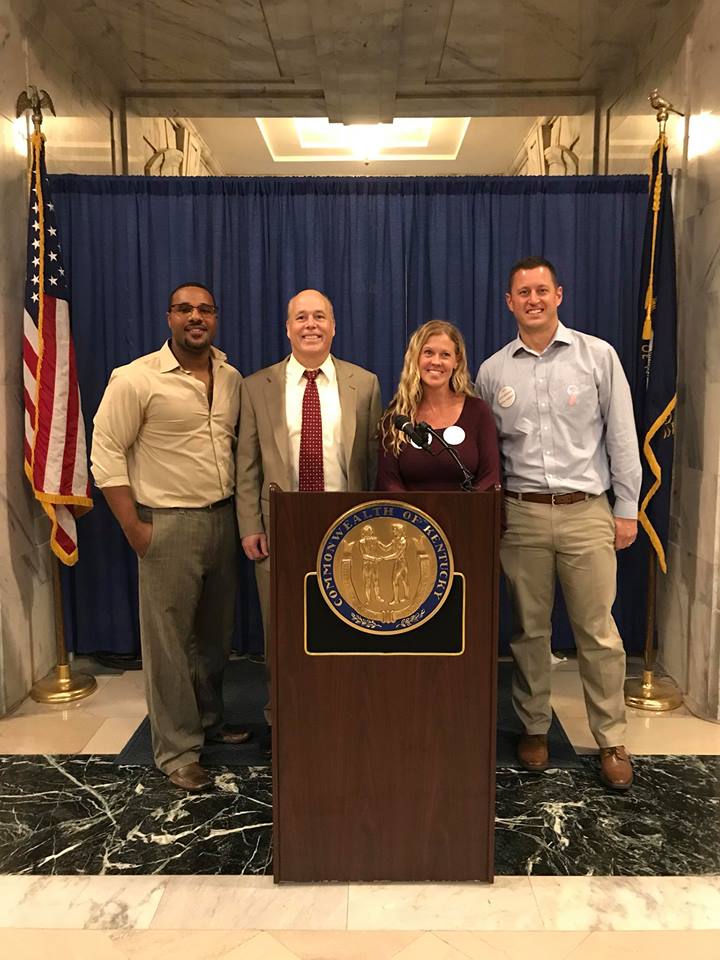
NPO is proud to announce a new direction for its Kentucky chapter. The team is bringing in two young shared parenting advocates with exciting plans for the future. Matt Hancock, current vice-chair, will be taking over. Jason Griffith, minority outreach director, will become vice-chair. Matt Hale will be stepping down as state chair to focus on national messaging and strategy while offering the new team his experience as a teammate. Alexandra Beckman will remain as women’s outreach director.

Hancock brings youth and energy to the chair position. He is a member of the “Kentucky Heroes” who helped pass the nation’s first shared parenting presumption in permanent custody orders. He has expertise in team building, relationship building with lawmakers and a calm demeanor. He has been assuming more responsibility over the last several months including media appearances.

Griffith, another “Kentucky Hero” who helped pass Kentucky’s shared parenting law, is a charismatic communicator. He has reached out to many lawmakers and been an effective communicator for Kentucky’s NPO. Griffith is a tireless advocate for children who also sidelines as an actor (https://www.imdb.com/name/nm8547124/). Griffith commented, “It has been an honor and a privilege to have had the chance to be a voice for our Kentucky children and their families. Every moment is an organizing opportunity and every minute there’s a chance to change the world.”

Hale’s time as Kentucky’s chair established him as unquestionably one of the nation’s leading shared parenting advocates. He started the Kentucky chapter in late 2012 and was the leader in getting 2017’s HB 492, the nation’s second shared parenting presumption temporary child custody order law, passed unanimously. He wrote the initial draft of Kentucky’s 2018 first in the nation permanent order shared parenting law. He led the effort for the law’s passage in every way including media messaging, volunteer coordination, lawmaker outreach and finished with being the lead testifier before Kentucky’s House and Senate judiciary committees. Hale’s last public appearance as state chair was his historic “Glorious Park” speech at the state capital Governor’s ceremonial signing.

“I’m thankful to have been chosen to be the messenger for this effort. It’s exciting to see two amazing men in Matt Hancock and Jason Griffith taking over Kentucky’s efforts. People rally to Matt because of his natural leadership, which will lead him to great things. Jason brings a rare level of charisma and steely determination that will make him a star. I’m honored to have worked with them and all of the greatest children’s advocates there are, the Kentucky Heroes. I wanted to thank Kentucky’s amazing lawmakers, Governor Bevin, the Kentucky Fathers Right Movement, Dr. Ryan Schroeder and the great people of Kentucky for putting children first. We made it to the glorious park of shared parenting where parents take turns pushing their kids on swings.”

NPO Kentucky team

  NPO Kentucky’s Leadership Team (from left to right): Jason Griffith, Matt Hale, Alexandra Beckman, Matt Hancock