Categories
Blog

The Guardian – Wrong, Biased on Child Support

May 10, 2019 by Robert Franklin, Member, National Board of Directors, National Parents Organization

Sigh.  The Guardian never seems to disappoint.  If you’re looking for a one-sided anti-father screed, The Guardian is usually happy to comply and this article is no exception (The Guardian, 5/8/19).

The subject is child support; the point of view: fathers are a sneaky lot who bend heaven and earth to avoid paying child support; this leaves custodial mothers living in poverty; and the child support bureaucracy is no help.

Needless to say, only one father is interviewed and he’s pretty happy with his situation.  That leaves all the complaining to be done by mothers and others who criticize the system.

Now, doubtless, the system needs criticism.  I’m sure the trauma described by the article of a mother trying to get some sort of action out of the massive Australian Child Support Agency is very hair-pullingly real.  I sympathize with anyone faced with that.

But guess what.  Custodial fathers have the same problems with mothers who don’t pay that mothers have with fathers who don’t.  But that reality is found nowhere in the article.  Indeed, if the article were the only information you had about child support in Australia, you’d justifiably conclude that only fathers are required to pay and only mothers are recipients.  You have to read fairly deep into the comments at the bottom of the piece to hear from fathers who’ve been stiffed by their exes.  For example:

My ex-wife kept one promise in our marriage. Just before our divorce, after I had been given sole parental responsibility, she promised I would not receive one cent of child support. She quit her job (nearly $100,000p.a as a chef). I found out all of the names she was working under and the bank accounts she was getting money into and gave that information to the Child Support Agency. Their first response was that I should be paying child support! Finally managed to convince then that the Family Law Court decision, had they read it in the first place, gave me custody and not her. Then the CSA suggested I not claim child support.

Now, I don’t have Australian data on child support at my fingertips, but if they’re anything like they are here in the U.S., non-custodial mothers there are significantly less likely to pay what they owe than are non-custodial fathers.  Here, mothers are less likely to be ordered to pay child support at all and when they are, they’re ordered to pay less than are fathers.  Even at that, they pay less of what they owe than do fathers.

Specifically, as of 2015, the Census Bureau reported that 52.7% of NC fathers were ordered to pay support versus just 39.6% of mothers.  Those fathers were ordered to pay $5,789 per year on average versus $5,600 for mothers.  And fathers paid an average of $3,491 (60.3% of what they owed) versus $3,200 (57.1%) for NC mothers.

So if there’s a problem of non-custodial parents not paying to support their children (and there is), the problem lies at least as much with mothers’ failure to pay as with fathers.  And yet the very concept is ignored by The Guardian.

Meanwhile, in order to grab readers’ sympathies, the article begins and ends with “Amanda,” a custodial mother with a daughter who’s about to start school.  We’re told that she lives at or near the poverty line and that her ex understates his income to reduce his child support obligation to her. 

But amazingly, the article that goes into his income in some detail never mentions hers.  There’s nothing to suggest she’s disabled or impaired, only that she barely makes ends meet despite receiving at least $1,500 per month in governmental housing subsidies.  The simple fact is that next to no one who’s able-bodied and reasonably well educated need live in poverty with just one child and herself to house, clothe and feed.  The article is intent on convincing readers that the fault lies with Amanda’s ex, but makes no effort to explain how or why his payment of $579 per month is the only thing that keeps the wolf from her door.

Then there’s the vital matter of access to the child.  It’s a vital matter because we know from well-established research that NC parents who don’t find their access to their children obstructed are far more willing and likely to pay than are those who do.  Is refusal of access part of the child support problem in Australia?  My guess is it is.  I do so because, as historian John Hirst has pointed out, Australian courts are uniquely unwilling to enforce orders of visitation.  Indeed, as a matter of policy and precedent, they simply don’t do it.  Alone among all the orders issued by Australian courts, those for child access are not enforced by the courts’ power of contempt.

So if there is a problem with child support payment, one obvious place to attack it would be there.  Not a word about the refusal to enforce visitation appears in The Guardian’s article.

That of course brings us to shared parenting.  By itself, a general rule giving equal time to each parent would greatly reduce the need for child support.  Parents could simply bear the costs incurred during their time with the child and equally share occasional or special expenses.  That would leave both parents with time to work and earn, neither being saddled with so much parenting time as to make it hard to work and earn enough for a decent lifestyle.  If mothers bear most of the brunt of whatever problems beset the child support system, it’s because courts hand them the lion’s share of the parenting time.  Fix the latter and we’d go a long way toward fixing the former.

Needless to say, The Guardian has never said a good word about equal parenting and of course the latest guidance offered to the Australian government is dead set against equal parenting following divorce or separation.

So there we have it: an article whose main mission is to flay fathers and complain about child support, all the while ignoring changes to the system that would make matters better for everyone.

In short, a classic Guardian piece.
Categories
NPO in the media

April 26, 2019 Kentucky New Era “Proclamation Emphasizes Shared Parenting” Matt Hale, National Board of Directors

This article originally ran in the Kentucky Era

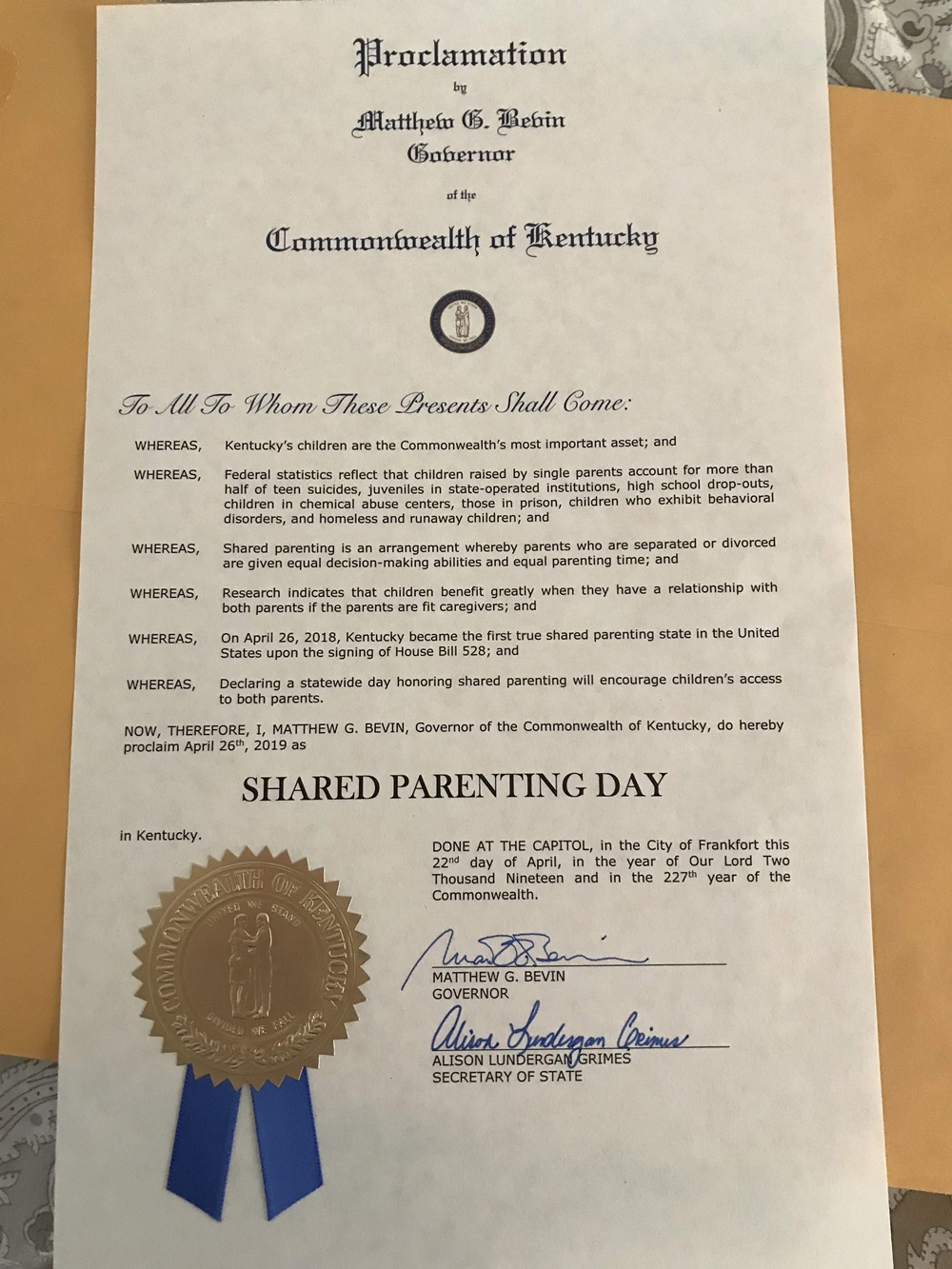
In the wake of last year’s legislative approval of a law on shared parenting, Kentucky Gov. Matt Bevin has proclaimed today Shared Parenting Day.

The proclamation reflects the need for parents to share equally in parenting their children during times of divorce or separation and Kentucky’s role in highlighting the issue.

According to the proclamation, Kentucky became the first true shared parenting state in the nation with the signing of House Bill 528 on April 26, 2018.

That bill was sponsored by Rep. Jason Petrie, who represents House District 16 including Todd, Logan and Warren counties.

He also sponsored a related bill in 2017.

Petrie said the proclamation brings attention to Kentucky’s leadership role in the matter.

“We’re leading the country on this issue,” he said.

The proclamation defines shared parenting as an arrangement where parents who are separated or divorced are given equal decision-making abilities and equal parenting time.

U.S. statistics note that children raised by single parents account for more than half of teen suicides as well as juveniles in state-operated institutions, high school dropouts, children in chemical abuse centers, those in prison, children who exhibit behavioral disorders, and homeless and runaway children, the proclamation said.   
SP Day Proclamation 1

Categories
Blog

Alabama Senate Passes Equal Parenting Bill

May 7, 2019 by Robert Franklin, Member, National Board of Directors, National Parents Organization

The Alabama Senate has overwhelmingly passed a strong shared parenting bill.  SB 266 passed the Senate by a vote of 25 – 4 and now goes on to the House for consideration.

Senator Larry Stutts is the lead sponsor of SB 266.  He had this to say about it and shared parenting:

“Parental equality should be the starting point for every child custody case,” Stutts remarked. “Ultimately, it’s about the child having a right to equal time with both of his or her mother, father, and extended family, provided that both parents are responsible adults.”

As I said, SB 266 is strong.  Entitled the Children’s Equal Access Act, it seeks to provide exactly that.  First and foremost, it defines “Joint Custody” as “equal or approximately equal time with both parents.”  It then establishes a rebuttable presumption that joint custody is in the child’s best interests.

In order to rebut the presumption of joint custody, judges would have to find by clear and convincing evidence that same is not in the child’s best interests.  The “clear and convincing” standard is second in stringency only to “beyond a reasonable doubt.”  That would make deviating from joint custody a tall order for judges.

In the same way, SB 266 would require judges to consult 16 enumerated factors including the fitness of the parents, any history of abuse, each parent’s home environment, etc. in order to rebut the presumption.

SB 266 would then require judges to explain in writing their reasons for not granting joint custody when they issue such an order. 

Finally, SB 266 retains the existing policy of the state:

It is the policy of this state to assure that minor children have frequent and continuing contact with parents who have shown the ability to act in the best interest of their children and to encourage parents to share in the rights and responsibilities of rearing their children after the parents have separated or dissolved their marriage.

All that of course militates strongly in favor of joint custody.

Alabama law now states that each parent should have frequent and continuing contact with their children, so why does the law need reform?  The Alabama Family Rights Association explains:

Results of surveys administered by the Administrative Office of the Courts (AOC) indicate that a biased and unbalanced practice still exists throughout the State of Alabama. See the State of Children in Alabama.  Approximately 40,000 Alabama children a year experience court ordered visitation with one parent for only two to six days a month.  Statistical results confirmed by Alabama DHR reveal that children lacking meaningful contact with one of their parents are more likely to be burdened by increased youth crime, school dropout rates, drug and alcohol use, teen pregnancies, teen incarceration, and bullying.

So, despite the clear preference of existing law, judges simply use the lack of definition of frequent and continuing contact to default to the old standard of every other weekend visitation.

I’ll report back on how SB 266 fares in the Alabama House.

Categories
Blog

The Cost of Fatherlessness

May 6, 2019 by Robert Franklin, Member, National Board of Directors, National Parents Organization

Read this (The Fatherless Generation).  It’s a good compendium of many of the social, behavioral, emotional, educational, etc. deficits kids experience correlated with fatherlessness.  It’s probably nothing you haven’t seen before, at least piecemeal, but there’s a lot here and it’s well worth brushing up on.

For at least a couple of decades, this type of information has been well known.  Way back in 1994 David Blankenhorn forced the world to confront the deep-rooted problems associated with fatherlessness.  Barbara Dafoe Whitehead did much the same in her 1993 article in The Atlantic Monthly entitled “Dan Quayle Was Right.”  We should have gotten to work then fixing the problem of fatherlessness.  Instead, we did the opposite.  We ignored the problem and vilified fathers and men generally for every imaginable slight and error, whether real or not.  We still do.

But, when you go down the list of the social ills associated with fatherlessness, ask yourself “How much does all this cost, not only in dollars, but in social dysfunction?”  You won’t get an answer, because the cost is literally incalculable, but the exercise will bring home to you the gravity of the problem and the madness of our current-day society that wakes up every day as if nothing is amiss with families and kids.

After all, there are too many other problems that are more pressing, right?  Income inequality is a big one.  But wait, there’s a huge fatherlessness component to that, as single mothers with minor children in the home are the most likely of all demographic groups to live in poverty.

Health care of course is an important issue.  Ah, but fatherlessness plays a big role in poor health care and health outcomes.

Children who live absent their biological fathers are, on average, at least two to three times more likely to be poor, to use drugs, to experience educational, health, emotional and behavioral problems, to be victims of child abuse, and to engage in criminal behavior than their peers who live with their married, biological (or adoptive) parents.

Teens in single mother households are at a 30% higher risk [of smoking, alcohol and drug abuse] than those in two-parent households.

Our incarceration rate is a problem.  But again, fatherlessness is a big part of that too.

Even after controlling for income, youths in father-absent households still had significantly higher odds of incarceration than those in mother-father families. Youths who never had a father in the household experienced the highest odds. A 2002 Department of Justice survey of 7,000 inmates revealed that 39% of jail inmates lived in mother-only households.

And so it goes, on and on.  Be it suicide, homelessness, mental health problems, poor educational attainment, low employment rates, teen pregnancy, crime, becoming a victim of child abuse or neglect, the list is long.  Every one of those problems tears at the fabric of society.  Attempts to address each one draw off much-needed funds from the public purse.

I’ve said it before and I’ll say it again: fatherlessness is the most serious social issue we face.  Courts and laws that encourage (or demand) fatherlessness are the bane of a sensible society.  Some sources of fatherlessness are hard or perhaps impossible to stanch.  But one approach is simple, the legal version of a slam-dunk – family court reform.  All that’s required for that is a slight tweak to existing laws and educating judges about the necessity of implementing those laws as intended.  We know what to do and how to do it.

As my own father used to say, “Time’s a-wasting.”

Categories
Blog

State Senator: Virginia Foster Care Audit ‘Absolutely Devastating’

May 4, 2019 by Robert Franklin, Member, National Board of Directors, National Parents Organization

Now it’s Virginia’s turn to fail its abused and neglected kids in foster care (Virginia Mercury, 12/11/18).  It’s not a new article, but it reports on an old, old problem.

Back in December, the state legislature received a report done at the behest of the Joint Legislative Audit and Review Committee.  It was, according to two lawmakers, a “devastating report.”

It was also a report that could have been written about many, many of the states in this nation.  The problems in Virginia are the usual ones.

Virginia Department of Social Services Commissioner Duke Storen said he agreed with the auditor’s findings.

“We have got a lot of things already under way because we’ve recognized these problems,” he said. “The fact is, we’ve got a retention problem, we’ve got a recruitment problem and we’ve got a training problem.”

Stated another way, Virginia doesn’t pay children’s welfare caseworkers enough and it weighs them down with too-large caseloads.  That means they don’t remain employed by the state very long and the ones who do remain have to pick up even heavier caseloads.  That all results in children not receiving the attention from the state they need and deserve.  One senator put it well:

“This is an absolutely devastating report,” said state Sen. Janet Howell, D-Fairfax. “These are children we’ve taken from their families. They’re now our children. We have to give them the very best we can and obviously that’s not happening.”

Indeed.  When the state takes kids from their parents, they become the state’s kids.  This is how it treats them:

Among other failures, the report found 19 percent of children in foster care did not receive all their required monthly visits from caseworkers between April 2017 and March 2018, and 24 children were not visited at all. Of children ages 5 and younger, 15 percent did not receive all their required monthly visits…

There is also evidence that many children aren’t receiving basic physical, dental and mental health care. Only 10 percent of a sample of 492 foster care children in 2017 had received the recommended immunizations and 45 percent had no medical record of immunizations at any time in their life.

A 2017 federal review found that local departments did not adequately assess the mental and behavioral health needs of nine out of 34 sample foster care cases — even though “a significant proportion of children in foster care in Virginia have clinical levels of mental or behavioral health needs,” according to the report.

And even though placing children with families is considered a widely-held best practice, local departments don’t do enough to place children in foster care with relatives. Only 6 percent of Virginia’s foster care children were placed with relatives in 2016, compared to 32 percent nationwide.

And of course there aren’t enough foster parents to care for all the kids taken by the state.  Or at least Virginia doesn’t think there are.  But whatever the case, the state has no intention of dealing with the shortage, if there is one.

The state has no plans to address the shortage of foster parents, which has persisted since at least 1998, Dickinson added. It doesn’t even have a basic list of all foster parents in Virginia.

That’s right, the shortage of foster parents has been a known problem for over two decades and Virginia isn’t even thinking about how to solve it.  Amazing.

Again, all that could be said about many states.  But there’s one thing that uniquely hamstrings Virginia’s ability to deal with its foster care crisis.

Overall, the report faulted limited oversight of a far-flung system of 120 local departments of social services, which are each independently responsible for the services they provide. The state, meanwhile, has limited power to intervene when things go wrong.  

It’s hard to imagine a state system that tasks 120 sub-agencies with providing services to kids but then refuses the state sufficient power over those sub-agencies to ensure each does its job well.  Needless to say, the quality of services provided to kids is uneven at best, varying from location to location.

It’s such a common story.  Reading about state after state that frankly fails its most vulnerable residents, it’s hard to conclude anything but that children simply aren’t as important as we claim.  Too few resources to do the job properly and too many incentives to take children from families and into the adoption pipeline mean damage to kids that’s well known and documented and yet it continues.

Categories
Blog

Proclamation emphasizes shared parenting

This article originally ran in the Kentucky Era

In the wake of last year’s legislative approval of a law on shared parenting, Kentucky Gov. Matt Bevin has proclaimed today Shared Parenting Day.

The proclamation reflects the need for parents to share equally in parenting their children during times of divorce or separation and Kentucky’s role in highlighting the issue.


According to the proclamation, Kentucky became the first true shared parenting state in the nation with the signing of House Bill 528 on April 26, 2018.

That bill was sponsored by Rep. Jason Petrie, who represents House District 16 including Todd, Logan and Warren counties.

He also sponsored a related bill in 2017.

Petrie said the proclamation brings attention to Kentucky’s leadership role in the matter.

“We’re leading the country on this issue,” he said.

The proclamation defines shared parenting as an arrangement where parents who are separated or divorced are given equal decision-making abilities and equal parenting time.

U.S. statistics note that children raised by single parents account for more than half of teen suicides as well as juveniles in state-operated institutions, high school dropouts, children in chemical abuse centers, those in prison, children who exhibit behavioral disorders, and homeless and runaway children, the proclamation said.   
SP Day Proclamation 1

Categories
Blog

How to Untangle a Tangled Web

May 2, 2019 by Robert Franklin, Member, National Board of Directors, National Parents Organization

It’s another case in which the law makes something hard out of something easy (Indiana Lawyer, 4/30/19).

Jessica Boyd and Jason Baugh weren’t married and had an off-again/on-again relationship.  During that time, Boyd gave birth to two children, both of whom Baugh acknowledged by affidavit to be his.  That constituted proof of paternity under Indiana law, so, when the two adults split up in 2010, the court ordered joint custody for Boyd and Baugh.

For unknown reasons, in 2017, Boyd asked Michael Litton to take a paternity test regarding the younger child.  She and Litton had had an affair during one of her breaks from Baugh.  Sure enough, DNA testing revealed Litton to have fathered the younger of the two children.

So Boyd and Litton went to court to establish him as the child’s father and to establish his parental rights.  But the trial and appellate courts said ‘No.’  Why?  Because Boyd and Baugh had already established Baugh as both children’s father and the law wouldn’t allow Boyd to attack that finding.

Now, from what I can judge, that doesn’t leave Litton out in the cold.  His mistake was filing an action with Boyd.  As I read the opinion, Litton can seek parental rights on his own and, as the biological father, probably prevail.  What that does to Baugh and his parental rights to the younger child is anyone’s guess.

But what a tangled web this all is.  If Boyd had simply told Baugh the truth about the second child’s paternity, i.e. that the father could be him or Litton, all of the subsequent years of litigation and expense would have been saved.  More importantly, both children would have known from the beginning who their respective fathers are.  As things stand, the second child will be put through the turmoil of learning that Baugh, the man the child has always thought of as “Dad” is in fact not his/her father.  Plus the child will form a new relationship with Litton, whatever form that may take.

In short, the tangled web is an emotional and financial disaster for adults and children alike.

Why is there no legal requirement that a woman simply tell the truth about paternity?  If she knows for certain who the father is, she should be required to tell him.  If she’s not sure, she should have to inform each man who may be.  Genetic testing can then sort the matter out.  In every other area of law we require the person with knowledge of material information to disclose it to the other party to a transaction.  Why not here?

Alternatively, why don’t we just test the genetics of all children at birth?  We perform dozens of other tests on them, so why not one for paternity.  At a stroke we’d untangle the web that’s caught Boyd, Baugh, Litton and one child.  Plus, we’d take a great leap toward ensuring that children can form real, meaningful relationships with their fathers from their first days.

The weird web of laws and customs by which we pretend to establish paternity, but that all too often gets the matter wrong, could be reformed in the blink of an eye and children’s best interests and adults’ emotional well-being and bank accounts would be served if we did.

Categories
Blog

Does Community Collapse Reduce Marriage Rates?

May 1, 2019 by Robert Franklin, Member, National Board of Directors, National Parents Organization

Why the retreat from marriage?  Marriage rates have been declining for years in this country, but exactly why they have remains unclear.  That’s because, while overall marriage rates are down, more affluent Americans tend to get and remain married.  Indeed, non-marital childbearing among women with a college education is about 8%, i.e. almost exactly what it was in 1960.  The decline in marriage is pretty much confined to blue collar workers and the poor.

And that’s a brain teaser.  Why would the very people who financially need marriage the most be the ones who tend to forego it?  Married men, particularly those with children earn significantly more than their unmarried and/or childless counterparts.  And in any case, the simple fact is that almost any adult can earn more than the incremental cost of his/her presence in the household.  Mom and baby require X amount to meet their expenses; add Dad and the household requires more money, but the increased amount is something all but the most dysfunctional adults can easily earn.  Two earners are better than one in almost all cases.

Plus, it turns out that, while declining earnings tend to be associated with a decline in the marriage rate, increased earnings don’t produce the opposite.  Journalist Timothy P. Carney makes the point here (Institute for Family Studies, 4/26/19).  Towns that may have seen a factory closed, reducing wages and the marriage rate, were economically rejuvenated by the fracking boom.  That created an excellent opportunity to study how people reacted to increased earnings.

[E]conomists Melissa Kearney and Riley Wilson of the University of Maryland studied similar fracking towns from Texas to Pennsylvania. Does boosting the wages of blue-collar men also boost marriage? If it did, this would strengthen the case that income determines marriageability.

But that’s not what happened. “[I]n response to local-area fracking production,” Kearney and Wilson found, “both marital and non-marital births increase and there is no evidence of an increase in marriage rates.” Furthermore, they concluded, “We find no evidence to support the proposition that as the economic prospects of less educated men improves, couples are more likely to marry before having children.”

 So the idea, advanced by some, that the economics of blue collar work (e.g. the sharp decline in manufacturing jobs) explain reduced marriage rates among that segment of society is dubious at best.  Why wouldn’t those rates move back up once the new oil field money improved the bank accounts of those workers?

According to Carney, it comes down to more than just money.  When the plant closes, that’s not all that goes.

[David] Autor’s study showed that the disappearance of jobs in a place led to a retreat from marriage in that place. This is true, but it skips a step: the factory closure is often the first domino to fall. The second domino to fall may be the coffeehouse next door—a complementary businesses that also serves as a community hub. Then people move out, and one of the churches closes. The old parishioners don’t want to go to the parish a town over, and so they stay home on Sunday. Social isolation spreads. The chain reaction, one by one, takes out the local institutions of civil society.

Tipping over the first domino can cause a chain reaction but standing the first one back up doesn’t cause the opposite reaction. Similarly, the death of blue-collar jobs can kill a community fairly quickly, but bringing back those jobs doesn’t bring back marriage. That’s because job restoration alone cannot instantly restore the local community institutions that support marriage—like churches, clubs, and local meeting places. These take time to re-emerge organically.

It’s an interesting idea and seems to comport with the science on the matter.  Certainly the many ways in which this society discourages marriage and encourages divorce apply equally to all people regardless of economic status.  And yet not all people react to those influences the same.  Specifically, the better educated you are and the more affluent, the less likely you are to produce children outside of marriage or to not get married in the first place.

And yet…

If the local church closes, it does to for the well-to-do as well as the blue-collar worker.  So why doesn’t the loss of those social resources impact elites the way they do others?  Carney’s answer doesn’t persuade.  

America’s elites still enjoy strong communities, planted thick with institutions—even if they call it “networking,” and don’t view it as anything special. In places where college degrees are rare and where factory jobs used to dominate, though, the little leagues, the swim clubs, the rotary clubs, and most of all the churches are fading away, delivering a death blow to family formation.

So “networking” is the all-purpose social institution of America’s elites?  I don’t buy it.  Carney does no more than make the assertion and that’s not nearly good enough.  He may be right, but he needs to demonstrate the fact, not just make the claim.

Plus, in Carney’s analysis, whatever happened to the well-known tendency of humans to band together when faced with catastrophe?  We see it invariably in natural disasters, so why not in economic hard times?  If the first domino to fall is the closing of the factory, why don’t people impacted by that band together?  Why don’t couples realize that now is the very time to marry, to pool resources?

Those are good questions that Carney doesn’t answer.  Still I think he’s on to something.

Categories
Blog

Kentucky Governor Speaks Out on First-Ever Shared Parenting Day

April 29, 2019 by Robert Franklin, Member, National Board of Directors, National Parents Organization

At the urging of NPO’s Matt Hale, Kentucky Governor Matt Bevin established April 26th as Shared Parenting Day.  He issued a proclamation saying so, but went a step further saying this:

“In recognition of the passage of HB 528 into law last year, I am designating April 26, 2019, as Shared Parenting Day in Kentucky.  Kentucky’s children are the Commonwealth’s most important asset, and shared parenting benefits our children by providing access to both parents following a divorce or separation, while also factoring in clearly defined exceptions.”

Indeed.  Children are not only our most important asset, but they’re our future.  Every child is the future of our society, our culture, our body politic.  Their well-being is the very core of what we’ve built.  The separation of children from their parents is a wrong that has no justification and certainly not in their “best interests.”

So shared parenting is a must for every state and country with laws on divorce and child custody, i.e. every single one. 

Shared Parenting Day in Kentucky was the brain child of NPO’s Matt Hale and he’s proclaimed yellow as its commemorative color.  That’s yellow as in “tie a yellow ribbon” that recalls families reuniting. “NPO Kentucky Vice-Chair Jason Griffith said that we needed a commemorative color and I immediately chose yellow for the sunny and Glorious Park that shared parenting is. Yellow ribbons for family reunification goes perfectly with it” , Matt stated.

And it turns out that other states may be following Kentucky’s lead.  NPO has already received calls from folks in New Jersey who inform us that they’ll soon be dunning their lawmakers for a similar commemoration there. Hale, creator of Shared Parenting Day, started this process by personally asking Governor Bevin and filling out the official request both last September. “Activists in every state should push to proclaim April 26th as Shared Parenting Day. April 26th memorializes the first state passing a permanent order shared parenting presumption and it also follows one day after National Parental Alienation Day. It’s the hope of a new day after a terrible night,” Hale said.

Thanks to NPO, Matt Hale and the Legislature and Governor of Kentucky, the Shared Parenting ball is rolling. Let’s make it so every day is Shared Parenting Day.

Matt Hale yellow tie 2

Matt Hale, creator of Shared Parenting Day, is the first to wear yellow on the first Shared Parenting Day

Categories
NPO in the media

April 26, 2019 The State Journal “April 26 declared shared parenting day” Matt Hale, National Board of Directors

Thanks to the efforts of NPO’s own Matt Hale, member of our Board of Directors and key player in the passage of Kentucky’s first in the nation shared parenting day, Governor Matt Bevin of Kentucky has declared April 26 “Shared Parenting Day.” Read the whole article here.